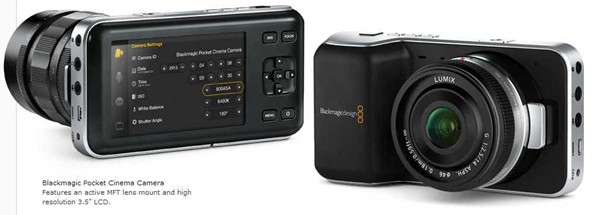
Portability meets performance with this itty bitty camera. Videographer, Bradford Hill took the Blackmagic Pocket Cinema camera for a test run, here are his thoughts on the camera's usability.****
Pros:
Price of $995 for the brains of the camera
The camera boasts 13 stops of dynamic range, for under $1000. This feature in technology is a major component to high-end cinema cameras. It preserves more detail in your image highlights and gives you a flatter less contrast image. Which is great for color correction, allowing the colorist more room to achieve different looks in post.
Lossless CinemaDNG RAW or ProRes 422 files recorded to fast SD Cards.
Lightweight but solid body design made of magnesium alloy.
Choice of Shutter angles.
Customizable Metadata entry.
Film or Video dynamic range recording modes for two different stylistic ways of shooting. Film gives you the flatter, wide dynamic look and video gives you an HD video essentially.
Supports a variety of lens mount adapters, which are cheap and give you a broad range of cheap & acceptable lenses.
2.5mm LANC Remote jack is cool to have with this camera if you are doing shoots that require this device.
Includes Blackmagic Design Davinci Resolve Lite, their entry-level color correction program.
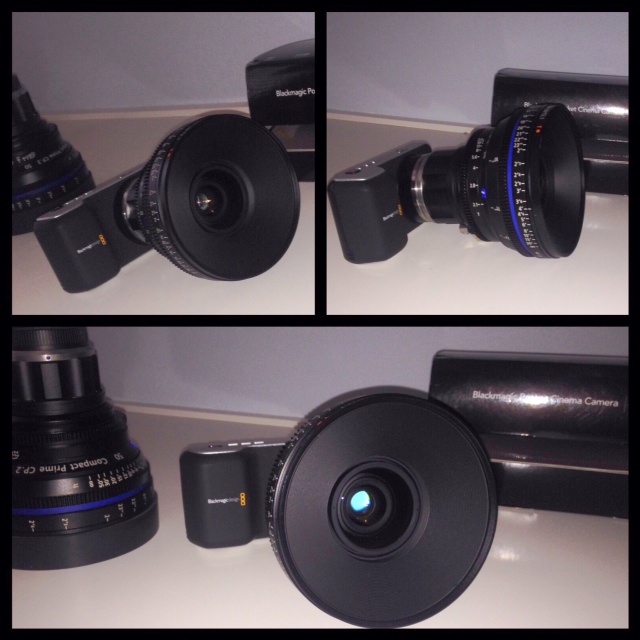
2.88X crop factor.
Short battery life (about 1 hour) and you can only charge them in the camera (Batteries cost $15 but again you must plan ahead as you can’t be charging a battery & using camera simultaneously.)
Four ASA (ISO) settings 200/400/800/1600 (not horrible but something to consider for varying shooting conditions.)
Lacking frame rates- Covers ranges of 23.98p, 24p, 25p, 29,97p, up to 30p (if BMD put a 60p frame rate in this camera, it would be one of the top competing cameras on the market.)
The lightweight & compact body is only good for saving space, the small design makes it near impossible to hold a steady shot handheld over a longer focal length.
Formatting cards only on computer (I didn’t find that be a huge problem, it just requires more planning and consideration on the users end.)
Recording formats will give you huge file sizes, which will require more cards and probably a faster computer. (Must use Extreme Pro SanDisk 64GB)
Input connections are not protected/covered – which over time could easily build up dust & dirt collection.
I didn't rely on the internal microphone at all; the resulting sound was very low & thin. Preferably it is best to not use the internal microphone and to use an external recorder.
Shooting handheld is near impossible, use a tripod or get a cage if you want to keep a steady shot and/or be able to pull focus at the same time.
No PL or EF Mount options so you must get lens adapters.
As an entry-level camera, you can expect to spend at least an additional $1,000 on lenses, memory, batteries, external audio recording, tripod/shoulder support.
Bottom line:
I could see this camera catering to the educational market, because it’s price is so low and the amount you can learn about film & video from the camera is huge. Despite having to own Micro Four Thirds lenses, essentially every student in a class could have a camera & the powerful Davinci Resolve Lite color correction software installed on their own computers, which happens to be a free download.
Mac OS X : http://www.blackmagicdesign.com/support/detail?sid=3948&pid=11735&leg=false&os=mac
Windows : http://www.blackmagicdesign.com/support/detail?sid=3948&pid=11735&leg=false&os=win
At its core, the BMPCC is a powerful cinema camera and requires the user to know the basics for best control. It is best suited in a professional cinematographers hand, but not a good choice for an amateur.