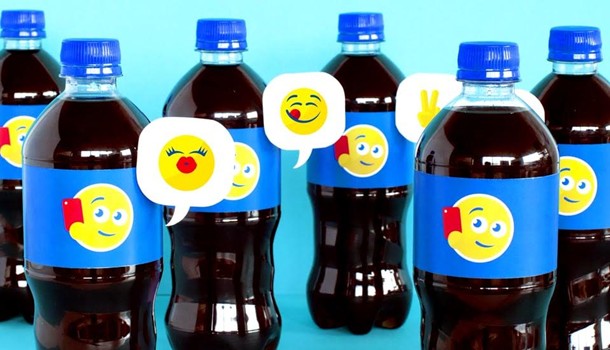
This summer, NYC-based music company Pull brought the digital icons known as emojis alive. Through three fun themes specializing in sound selection, they created Pepsi’s summer Instagram campaign celebrating World Emoji Day.
Pull composer Mitch Davis gave each 14-second spot a different musical expression of emojis, which were animated in the ads (created by agency The Barbarian Group) by old-school stop motion techniques. “Texting” has a breezy guitar riff bouncing off a perky rhythm, “In The Club” features a blatantly programmed beat with a buzzing bass, and “Football” puts emojis on the playing field backed by a drum corps-style drumline. All sound design for the spots was also created by Davis and Pull Executive Producer Scott Brittingham.

Davis – who has collaborated with the likes of U2, Danger Mouse, and Bobby Womack in his NYC studio -- fielded questions about the specific challenges of this campaign.
PH: How do you approach composing specifically for social media?
Davis: I wanted to have something that would translate well on a phone or earbuds, because we know a lot of people are watching it that way. The nature of the way the media is consumed defines what it should sound like: If you’re composing something that’s going to be played back in a big movie theater, for example, that’s a system that can handle higher levels of bass than earbuds or a phone speaker. This wasn’t going to be played in a large 7.1 system so I simplified the mix to match the simplified visuals.
Since the visuals are cartoonish versions of the real thing – a club, a football game – we wanted the music to match that. What you hear is a fun shorthand for these environments. A lot of times there’s literal music and sound design, where you’re trying to match the sound of the space and the accompanying perspective changes, and match the action with Foley. Whereas this is more interpretive, like, “OK, football – let’s do a drumline!” It’s sonic shorthand, in a way that feels comedic.
PH: Once you’re recorded the music and sound design, how do you mix it so that it sounds right? How is that approached differently than if it were for TV or film?
Davis: I intentionally kept the music as “flat” as possible, in keeping with the two-dimensional world of the emojis.
These are digital smiley faces living in a flat visual plain, so it wouldn’t be logical if the sound were coming from every direction. As a result, we mixed the tracks mostly in mono, and we kept all spatial effects like reverb or delay to an absolute minimum. In addition, every live instrument that we used was mic’d as close as possible.
To test the mixes, we listened to them on our phones before we sent them to the client for review.
PH: Ultimately, how do the sounds that you’ve created enhance Pepsi’s emoji campaign?
Davis: The music and sound design combine to give the characters a voice. My job was to figure out their personality, then get it recorded, and this campaign was a lot of fun for me. I like its old-school, down-and-dirty, stop motion animation style – instead of trying to be super-slick. It’s definitely refreshing.
Pepsi from Pull (a music company) on Vimeo.