By Frank Brault, Product Marketing Manager – Entertainment at Vectorworks, Inc.
From concerts and plays to exhibits and conventions, live event production designers do it all. With the wide variety of venues and client demands, production designers operate in a high-pressure industry where they have to be flexible and able to adapt to given settings, which can be difficult when you’re hundreds of miles away from the site and your design associates are unable to travel to the venue and see what you’re working with. Traditional documentation can help designers gain an understanding of what they’re working with, but it’s not the same as experiencing a physical space for themselves. However, with the rise of virtual reality (VR) technology, there is an improvement to this problem.
If you’re still getting up to speed with VR, it’s technology that allows you to “walk” and “explore” a 3D simulation. Nowadays, most people are familiar with immersive technology because of Pokémon Go’s popularity, showcasing the accessibility of augmented reality (AR). While AR and VR are both classified as immersive technology, AR is a little different. It superimposes a the computer-generated image on a user’s view of reality in real time, like a new scenic design on an existing stage, while VR technology generates a virtual 3D simulation that allows users to immerse themselves into designs like being in a computer game.
When it comes to the production design process, these technologies could give designers a leg up when it comes to the initial research and explorative stages to better understand a space. Rather than just working
Currently, the expensive price tag surrounding VR technology like Oculus Rift or HTC
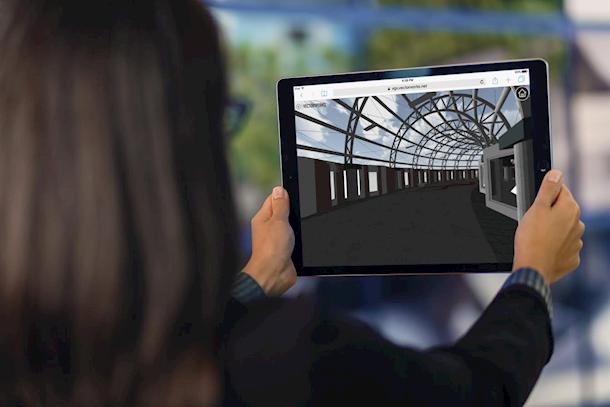
With this technology, the only requirement is the need for a 3D model and seeing as most projects have some 3D aspects, virtually anyone can use this functionality. You can try out a Vectorworks model in web view and virtual reality here. If you’re on a desktop computer, you can click and drag to move around the model in 360-degree mode. If you’re on a smart device, enable
So, now that you know how simple it is to make use of virtual reality, you might ask: what’s next? I think Pokémon Go’s usage of augmented and mixed reality, where you can see your location-specific information in your existing reality, is a telling sign for the design industry. I envision live event production’s usage of virtual reality will continue to expand and become much more accessible and common, eventually leading to augmented reality functionality similar to Pokémon Go. With AR technology, designers will be able to experience a compelling proposed design while standing in the pre-existing venue. By being able to see the different design elements in the context of the space, you’ll be able to spot improvements needed to perfect your project, leaving you confident and positioned for success.
About **Vectorworks **
Vectorworks cares about design. Since 1985, they have served the architecture, landscape, and entertainment industries, drawing inspiration from the world around and encouraging the more than half a million designers who use their software to create experiences that transform the world. To learn more about other products from Vectorworks, click here.