As a Producer for more than 30 years, I've interviewed many people, from celebrities (Charlize Theron and the Cast of the Forbidden Planet)* to astronauts (Sally Ride); from Little League Baseball Coaches (world-champion Chula Vista coaches) to college Presidents (Dr. Stephen Weber, SDSU); from athletes (John Tomac and Julie Foudy) to movie directors (Sam Raimi); from scientists (J. Craig Venter) to Presidential hopefuls (Hillary Clinton)*. I'm grateful that I've been able to exercise my innate curiosity about people throughout my career.
It's this very curiosity that drives an interview. Regardless of whether you've been interviewing for years or you're just starting out, you are capable of conducting conversations that elicit gold nuggets known as “sound bites," and that's what I'm sharing with you today: ten steps to an incredible interview.
1) Before the interview, via email or a quick telephone chat, inform the interviewee that you'll be asking questions about a general topic. Don't send specific questions, as that leads to memorization and before you know it, your editor will be dealing with Wood Person on video. No one wants that, least of all the interviewee. In certain corporate interviews, a legal team member may need to be present to approve all answers.
2) On set, after sound, camera and lighting are in place and the DP is ready to roll, start by shaking your interviewee’s hand as you make eye contact. Give them a nice smile. “We’re just going to converse with each other,” tell them; “Have a seat, and let's begin.” Have them include your question in their answer so when asked “What is your favorite color?” they can say “My favorite color is blue.” Or when asked what their favorite football team is, "I am a fan of the Chargers."
3) Reassure the interviewee that any mistake they make is not etched in stone; they can do it over; they’re not live; that is what editing is all about.
4) The first question to ask when “tape is rolling” is “What is your name and how is it spelled? And what is your title?” This is for the editor’s benefit so that lower-thirds captioning will be correct.
5) If your "subject" delivers an answer that seems a bit longer than what you can use in the video end product, then say, “That was really good. Now I want a version that incorporates those points in a shorter bite.”
6) The most profound technique is The Pause. When it seems like your subject has concluded a thought, wait one more beat (under no circumstances should you ever “step on them” by talking before they’ve finished their thought.) That two-second beat can lead the interviewee to plumb deeper. Let your silence be a question.
7) During the course of the interview, you'll most likely be working with a list of questions. But if the interviewee provides any answers that veer in a certain direction, ride along, like it’s a wave, and see where it takes you. "Tape is cheap," as we used to say back in the old days. Once you've completed that thought, then refer back to your list of questions.
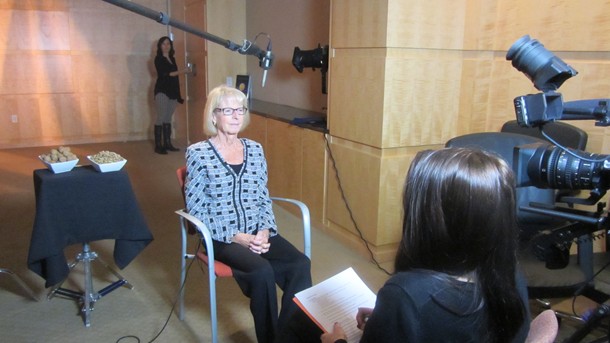
8) For best results on video, make sure that you, as producer and the one asking questions, sit or stand as close to the camera as possible so that the interviewee looks at your face and eyes at all times. If their eyes dart around or go up because they are thinking of how to phrase their answer, instruct them to think of the answer and then when they’re ready to reply, look at you. The closer they can look towards the camera (but not into the camera) the better, as an interview is much more compelling when the TV viewer sees the interviewee’s face and expressions. Interviews conducted with the interviewee in profile come off as though an amateurish news team got to the press conference too late for a good spot and ended up with the profile. I can’t think of any good reason to do it that way on purpose. Yes, we see the rules broken on that all the time, but you really need to know the rules well before you can break them; otherwise you come off like a rookie.
9) As the interview continues and your interviewee has visibly relaxed and is now providing smoother sound bites, then you might want to revisit the first few questions when they were more nervous nervous, and go for different answers.
10) The last question to ask is this: “Is there anything I haven’t asked today that you would like to add?” That sometimes turns out to be the most important soundbite of all. It may stimulate a gold nugget that you may not even have thought about. If they say “No,” then that’s it. It’s a Wrap.
About the Writer

Patty Mooney is a VP, Video Producer, Video Editor, Sound Technician and Teleprompter Operator at award-winning San Diego video production company, Crystal Pyramid Productions. You can find more of her Video Production blogs at Diary of a Video Crew.