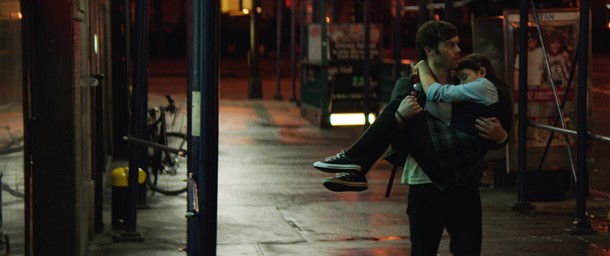
On the heels of director’s Shawn Christensen’s Oscar winning short film, “Curfew” (2012), his highly acclaimed feature film “Before I Disappear” (2014) premiered on November 28. Jerome Thelia, colorist and post-production supervisor, is a member of the talented gene pool that brought both these films to fruition.
In a recent interview, Jerome discussed his role on for “Before I Disappear.”
Q: Tell us how you developed your DI workflow for “Before I Disappear”.
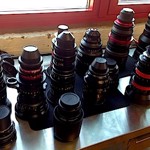
A: I’ve worked with Shawn Christensen (director, writer, and actor) and Daniel Katz (DP) on a variety of projects over the years and we’ve developed an easy rapport so that we’re tuned into the work methods and mindset of each other. Shawn and Dan wanted to continue with the epic yet intimate vision started on “Curfew”, which shooting anamorphic can impart. We did some tests with both RED and ARRI cameras, a variety of anamorphic lenses and chose the Hawk Vlite lenses. Because of the additional expense it wasn’t easy to convince producers that we should go ARRI RAW. But with so much shooting at night we knew that ARRI RAW was key to getting the kind of nuances and richness Shawn wanted in the shadows.
Q: How did the film’s look come about?
A: In “Curfew” we helped pioneer the use of film in the grading process, something I’ve called a film intermediate. You can hear and see all about it in a Studio Daily webinar I did a couple of years ago: https://vimeo.com/35973323. Unfortunately our budget and schedule for “Before I Disappear” just didn’t permit us to do a film intermediate.
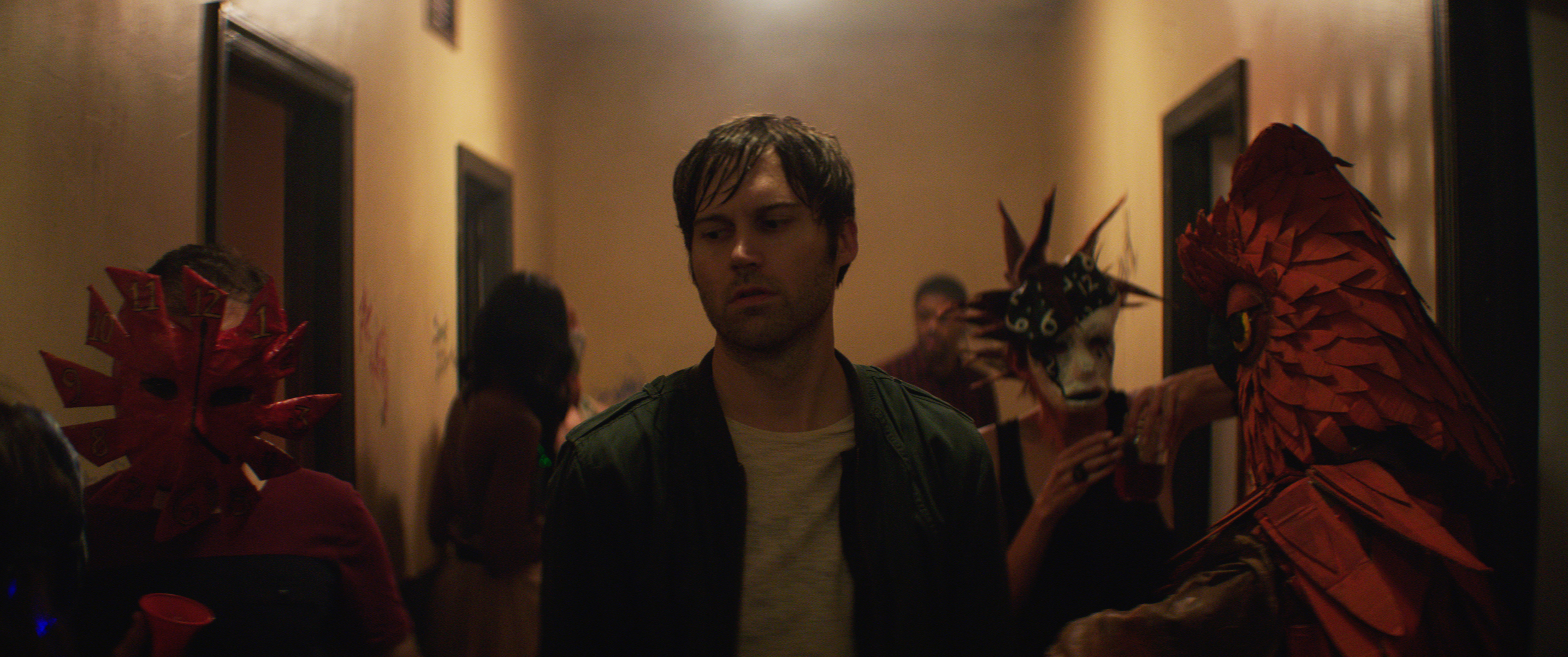
In any case we wanted a similar look to “Curfew”, but being a more expanded story “Before I Disappear” was going to include more night and daytime shooting, as well as comic moments. With the ARRI Alexa camera and anamorphic lenses, we were able to expand the palette of this film to be more saturated, cleaner, and warmer. Andrew Hubbard, our gaffer, and Dan did some beautiful work with colored accent lights. Much of the film takes place in clubs where there are strong color casts and the grade emphasized that - a flood of red with blue accents. There’s more warmth in “Before I Disappear”, but it still has a sad edge to it. I call it melancholy warmth, a seemingly contradiction in terms. As with music, it’s often possible to develop a kind of visual irony by going against the mood of the moment.
**Q: What DI software / workflow did you use? **
A: I used ASSIMILATE’ SCRATCH. It’s a great tool for any RAW format – ARRI Alexa, RED, and Sony. And ASSIMILATE’s proprietary fast debayer tool for ARRI RAW is amazing -- it essentially works like a RED Rocket for ARRI RAW.
It’s also GPU accelerated and really has excellent features and robust quality, which translates into real-time performance -- even with several layers.
ARRI RAW in anamorphic is just shy of 4K resolution and requires a 12 percent upres. SCRATCH has the excellent scaling algorithms that are especially important when doing an upres. With the fast and high quality scaling, and fast debayer tool, I was able to work in real-time at 4K, even using a fairly old GPU, the Quadro 6000, which I really did not expect.
Once I realized that I wouldn’t have to spend a lot of time transcoding footage, doing a separate scaling pass, and working with proxies -- none of the mind-numbing work that is sometimes required to finish with 4K RAW -- I was just able to be creative.
Q: How did you handle VFX shots?
A: Although “Before I Disappear” is not a VFX heavy film, there were a dozen shots with fixes. SCRATCH really excels at being the hub in a VFX workflow. We’re able to round-trip shots to VFX artists, keeping them LOG-C color, ungraded and unscaled at any time during the DI. This means that we can grade the shots before, during or after the VFX process and get the same result.
I also did a certain amount of stabilization, slow-motion and touch-ups myself. I was able to stay in SCRATCH for a large portion of this work, which saves a ton of time.
Q: Do you use PCs or Macs? And with what graphics cards?
A: I have two SCRATCH workstations -- one Windows, one Mac. In my case the faster GPU, the Quadro 6000 with SDI out, is on the PC. I also have a Cubix PCI expansion chassis with two RED Rocket cards. I can switch between workstation so that I can be rendering dailies on one machine while grading on another. Both machines are connected to a Sony OLED production monitor and a Panasonic plasma.
Q: What else do you have on your plate?
A: I’m directing a feature documentary called “Bounce” about the evolution of the ball, www.bouncethemovie.com. The film is based in part on a book by Anthropologist John Fox entitled “The Ball: Discovering the Object of the Game”. It’s an incredibly ambitious project that traces the development of ball games and their evolutionary role in animal play to ancient games through to modern sports and video games. We’ve been all over the place - traveled to Brazil twice, including during the World Cup last summer. We were in the Democratic Republic of Congo filming Bonobos playing ball in a protected sanctuary. We filmed the Mayan game of Ulama in Mexico; the ancestor to football in Scotland called the Ba’; and cricket in India, to name a few. We’re in the final stages of production now and hope to have the film in festivals in 2015. The film has has three gifted cinematographers I’ve worked with a lot - David McLain, Trevor Tweeten and Daniel Katz. Needless to say I’ll be the colorist on the project!