The first question you may be asking is what is SEO? SEO stands for search engine optimization and it basically means optimizing your business’s online presence so your business ranks higher in Google search results. Generally, the higher your business ranks in Google search results the more customers and business you get from your website.
Studies have revealed that 97% of consumers use the internet when researching products or services in their local area (BIA/Kelsey) and 78% of mobile searches for a local business result in a purchase (LSA|14). Accordingly, if you’re not paying attention to SEO you are missing out on a serious opportunity to get new clients.
Follow the SEO tactics below to help your small business start ranking better on Google.
Start Tracking Your Site Analytics
If you haven’t already, sign up for a free Google Analytics account and add your account’s unique tracking code to your website. Then set up Google Search Console for your site. These Google Analytics and Google Search console tools will help you gather lots of useful data about your website like how many site visitors you get, what site pages’ visitors visit most often, how long site visitors stay on each page, what keywords your site is ranking for, etc. After you’ve set up these tools for your site, it will be easier for you to track the impact of changes you make on your site - SEO or otherwise.
Find and Focus on Specific Keywords
Use a tool like Google’s Keyword Planner or SEMrush to discover search terms or keywords related to your business and see how many people per month are searching for those keywords.
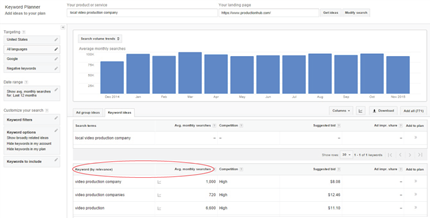
Once you’ve identified a few top search terms with a high volume of monthly searches try plugging those into a Google search and seeing what results come up (Tip: Make sure to use an Incognito browser window so that your search results are not personalized to you).
Now ask yourself, are the results you’re seeing relevant to you and your business? Would your site fit in or be appropriate with the other sites you’re seeing? After doing this, decide on 15-20 main keywords you’d like to try and rank for with your business website.
Next, decide which pages of your site you’d like to target on each keyword then incorporate that target keyword into that page’s title tag, content, etc. Normally, try to only use the exact target keyword and synonyms of it a few times on the page - so don’t just stuff the page with the same keyword over and over again. It’s more important to have user-friendly content than something written for search engines. The goal is to make your specific site page a great resource for people searching for the specific term you’re targeting.
Optimize Your Site for Local
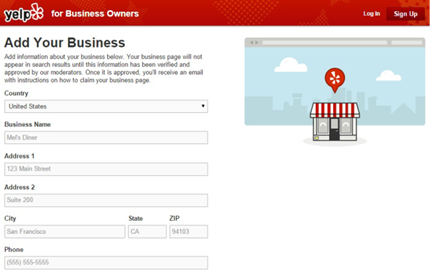
Google will give your business higher priority in the local search results if your business has lots of local citations with your business name, address, and phone number (NAP) all consistent. This is a trust signal to Google so it’s important to work on creating as many consistent local citations as you can for your business. Here are great lists of local citation sites to get you started, one master list and one sorted by business categories. Also, encourage your customers to leave reviews on sites like Yelp and Google+. Good reviews are great trust signals to potential customers looking into your business or service.
Earn Links to Your Website
The aforementioned tactics aren’t enough; you also need to earn/build links to your website. Recent data suggests if you want to rank for any competitive search terms – think “local video production company” – the chances of you ranking without external sites linking to your website are very slim.
So how do you earn or build external links to your site?
Create and promote valuable relevant content for your company (this is sometimes referred to as content marketing). This content can be in any form; a written post, a study, a video, an infographic, an online quiz, etc. really anything that relates to your business and that would be of interest and shareable among your target consumers.

One thing that can help you create interactive, shareable content is the content marketing toolset by Boombox. Boombox is a creative suite for companies that allows you to easily create and share content like quizzes, polls, and lists.
The idea is to create valuable content on your site and then promote that content to bloggers or other sites you think might be interested in sharing it. As more people see and share the content you’re creating you will naturally start to get more links to your business website and this will help improve your site rankings.
Conclusion
If you set up your site analytics, focus on specific keywords, improve your business’ local footprint, and start naturally building links to your website, chances are you’ll start seeing more customers coming to you from your website within a few months. Because there really is so much to the constantly changing world of SEO, should you decide to go with a company to help your site rank better on Google, consider contacting a company like Big Leap, a Utah based SEO agency.
About the Writer
 Matt Casady is an Online Marketing Specialist at Big Leap, he has a background in advertising and specializes in local search and content marketing.